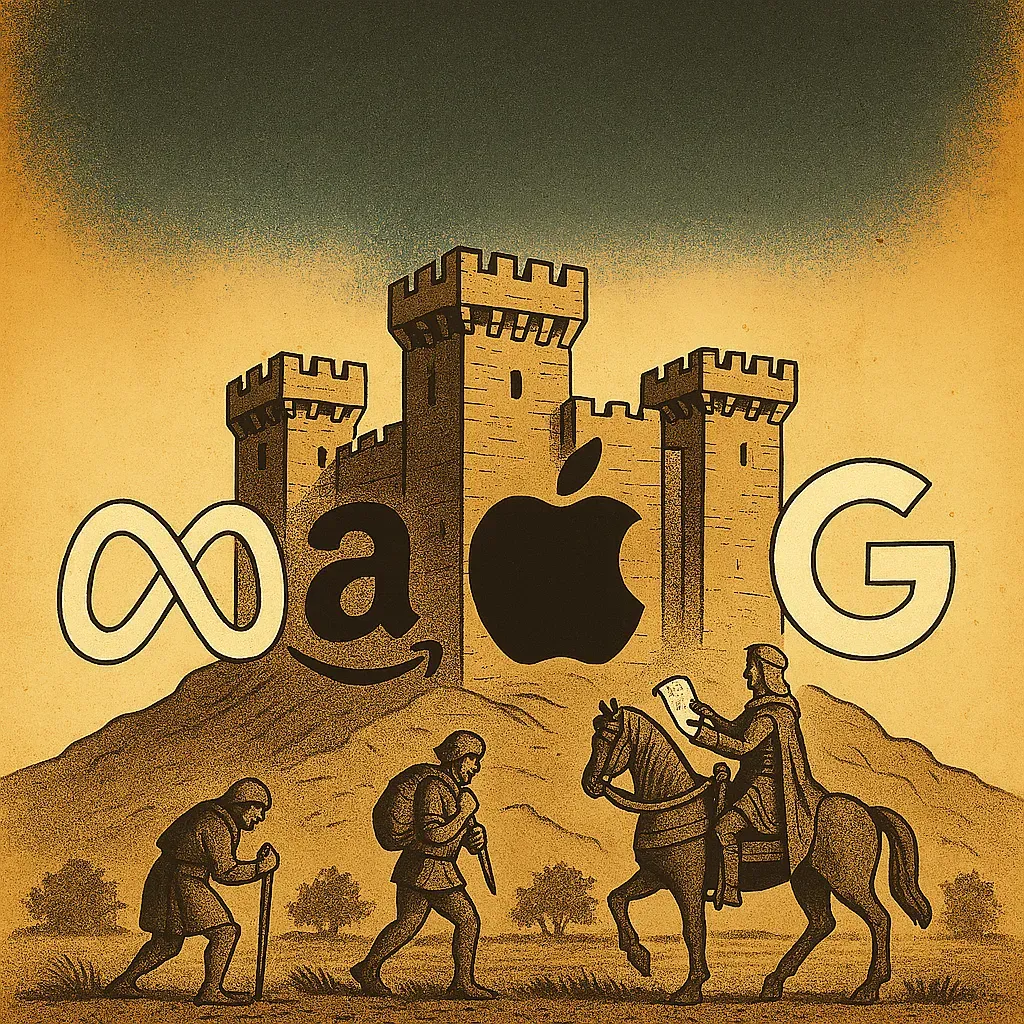
Have you ever felt like you’re working for free for Big Tech companies? Every time you post on social media, write a review, or even just let Google track your location, you’re creating value that these companies monetize—while you see nothing in return. According to economist Yanis Varoufakis, this isn’t just unfair capitalism; it’s something much worse: technofeudalism.
Many of us trace the tipping point back to two intertwined inventions: third-party marketing cookies and the first generation of mass-market social networks. Cookies popped up in the late-1990s, letting advertisers follow us from site to site, while MySpace, Facebook, and other social platforms exploded in the mid-2000s, coaxing us to pour our personal lives into their data-hungry feeds. Together they quietly transformed the open, “simple” web into a sprawling surveillance grid. That silent shift—turning human attention into a commodity—laid the groundwork for the cloud capital Varoufakis says now powers technofeudalism and its walled gardens.
In his 2023 book Technofeudalism: What Killed Capitalism[1]Varoufakis, Y. Technofeudalism: What Killed Capitalism. Melville House, 2023., Varoufakis argues that we’ve already entered a post-capitalist world—but it’s not the utopia many hoped for. Instead, we’re living in a digital version of medieval feudalism, complete with lords, serfs, and vassals.
From Markets to Digital Fiefdoms
I remember when the internet felt like an open frontier. Those days are over. Today’s digital landscape looks more like medieval Europe, carved up into territories controlled by a handful of tech barons.
Take Amazon’s marketplace. From the outside, it looks like a bustling market with millions of sellers and buyers. But look closer—every transaction, every search result, every price is controlled by Amazon’s algorithms. Jeff Bezos doesn’t compete in this market; he owns it and charges everyone else rent to participate.
Varoufakis puts it bluntly: “It might look like a market, but it’s anything but—it’s a privately controlled domain where Bezos’s algorithm decides who sees what.”[1]Varoufakis, Y. Technofeudalism: What Killed Capitalism. Melville House, 2023.
The Apple Tax and Other Digital Tolls
Apple’s App Store used to be the textbook example of this feudal dynamic[1]Apple Inc. “App Store Review Guidelines.” Apple Developer Documentation, 2024.. For years, if you wanted to reach iPhone users, you had to sell through the App Store and pay a flat 30 % commission—what developers dubbed the “Apple tax.”
That changed after a series of U.S. court rulings and mounting regulatory pressure. Today, Apple must allow developers to direct users to alternative payment methods and can no longer insist on the full 30 % cut. In practice, Apple still takes a smaller fee (currently around 12-27 % depending on the circumstances), but the once-immutable 30 % toll has been cracked.
Even with these concessions, Apple’s control over the iOS ecosystem remains formidable: it decides which apps get listed, sets many of the rules of engagement, and still skims a percentage of most transactions. In other words, the rent is lower—but the landlord still owns the land.
Google, Meta, Amazon—they all operate similar fiefdoms, each controlling different aspects of our digital lives.
The Three Digital Classes
In this new technofeudal system, Varoufakis identifies three main classes:
Cloud Serfs Every time you post on Facebook, upload to YouTube, or review a product on Amazon, you’re doing unpaid labor. Your content and data create value that platforms monetize, while you get nothing but digital dopamine in return.
We’re tied to these platforms by network effects and convenience—just like medieval serfs were tied to their lord’s land. Sure, you can leave Facebook, but you’ll lose all your social connections and data.
Cloud Proletarians These are the gig workers: Uber drivers, Amazon warehouse employees, food delivery couriers. They get paid (unlike serfs), but their every move is monitored and controlled by algorithms. They’re the digital age’s factory workers, except the factory is an app that can “deactivate” them without human oversight.
Vassal Capitalists Small businesses and entrepreneurs who depend on big platforms to reach customers. A startup making apps is a vassal to Apple. An online retailer is a vassal to Amazon. They’re technically independent but must pay tribute (fees) and follow the platform’s rules or risk being cut off from their customers.
Why Rent Beats Profit (And Why That's Bad)
Here’s the key insight: traditional capitalism runs on profit from competition and innovation. Technofeudalism runs on rent from controlling access.
But what exactly is the difference between profit and rent? Varoufakis emphasizes that while they may look similar on a balance sheet, the distinction is “subtler, qualitative, almost abstract”—yet fundamentally important for understanding our economic future.
Profit: The Engine of Value Creation
Profit in traditional capitalism comes from creating new value through production and innovation. Here’s how it works:
-
Value Creation Through Innovation When a company like Sony invented the Walkman, they created something that didn’t exist before. Consumers were willing to pay more than the cost of production because the product provided genuine value. This is profit earned through innovation—the company made the world better and was rewarded for it.
-
Competition and Vulnerability Profit is inherently vulnerable to competition. When Sony’s Walkman became successful, competitors rushed in with similar products, driving down prices and profits. This competitive pressure forced Sony to keep innovating or risk losing market share. As Varoufakis puts it: “Profit is vulnerable to market competition, rent is not.”
-
Risk and Reward Profit represents a reward for taking risks. Entrepreneurs invest capital and effort into uncertain ventures, and when they succeed, they earn profits. This system encourages innovation because the potential rewards justify the risks.
Rent: The Toll of Scarcity
Rent operates on a completely different principle. It’s income generated not through creation, but through control of scarce or essential assets.
-
Privileged Ownership Rent comes from owning something in fixed supply that others need. Classic examples include land (there’s only so much land in a desirable location) or natural resources. In the digital age, it’s platform access—there’s only one App Store for iPhone users, only one Amazon marketplace that reaches millions of customers.
-
Passive Extraction Unlike profit, rent doesn’t require creating new value. The rentier may do nothing to improve the asset yet still collect income. Varoufakis gives a vivid example: if you own a building in a neighborhood that others are developing, your rent income rises even if you do nothing—“you literally get wealthier in your sleep” as property values climb due to your neighbors’ enterprise.
-
Invulnerability to Competition This is the crucial difference: rent is resistant to competition. If you own the only bridge across a river, competitors can’t easily undercut you by building another bridge. In fact, competition in the broader market can actually increase your rent. As Varoufakis explains: “Market competition is the rentier’s friend.”
The Digital Transformation: From Profit to Rent
Varoufakis estimates that 35-40% of GDP is now being siphoned off as “cloud rents”—money that disappears from the productive economy into the pockets of platform owners[1]Varoufakis, Y. Technofeudalism: What Killed Capitalism. Melville House, 2023..
-
The Apple App Store When independent developers create apps, they do the work of innovation and value creation. But Apple skims 30% off every sale simply because they control access to iPhone users. Apple contributes nothing to the actual development of the app, yet extracts a significant portion of the developer’s earnings. This is pure rent extraction.
-
Amazon’s Marketplace When Amazon takes a 40% cut from sellers, that’s money that can’t be reinvested in new products or better wages. The seller creates the value (the product), but Amazon extracts rent for access to customers.
Why This Shift Matters
The transition from profit-driven to rent-driven economics has profound consequences:
-
Stifled Innovation Why compete when you can just buy out potential rivals or control the platform they need to reach customers? When rent extraction becomes more profitable than innovation, the incentive to create new value diminishes.
-
Increased Inequality Rent tends to concentrate wealth among asset owners, while profit (in theory) gets distributed among workers, investors, and reinvested in growth. Platform owners become digital landlords, extracting wealth without creating proportional value.
-
Economic Stagnation Rent is finite—it just redistributes existing income rather than generating fresh output. As Varoufakis warns: “If the economy starts to run on rent, it will stall.” When too much wealth flows to rentiers, there’s less available for productive investment and innovation.
-
Loss of Choice When a few companies control essential digital infrastructure, we become digital serfs—dependent on their platforms and subject to their rules. Just as medieval serfs were tied to their lord’s land, we’re tied to these platforms by network effects and convenience.
The Democracy Problem
Perhaps most troubling is how this rent-driven system affects democracy. Platforms discovered they make more money when users are angry and engaged, so algorithms promote outrage and division. As Varoufakis notes, “Platforms discovered that we spend more time producing free content for them if we’re angry.”
The result? Public discourse becomes increasingly fragmented and hostile—exactly the opposite of what healthy democracy needs.
Fighting Back: What Can We Do?
Varoufakis isn’t just diagnosing the problem; he’s proposing solutions:
Immediate Steps:
- Tax platform transactions (like a 5% fee on Amazon marketplace sales)
- Enforce interoperability (so you can move your social connections between platforms)
- Strengthen antitrust enforcement against Big Tech monopolies
Longer-term Vision:
- Establish data rights (you own your data and can be paid for it)
- Create publicly-owned alternatives to key platforms
- Develop collective ownership models for digital infrastructure
I’ll write more about his alternative vision in a future post as well as my critique of it on the next post.
The Bottom Line
Whether you fully buy into the “technofeudalism” label or not, Varoufakis highlights real problems with how digital platforms have concentrated power and wealth. The internet—once hailed as a great democratizing force—increasingly feels like a collection of walled gardens controlled by a few tech barons.
The first step toward change is recognizing what’s happening. Just as medieval serfs eventually realized their situation wasn’t natural or inevitable, we need to understand that our current digital economy isn’t the only way things can work.
References
Additional Sources and Further Reading: